

Lead-Free Crystal: Composition, Safety, and What to Know
Lead-free crystal is glass formulated to achieve the brilliance and weight of traditional lead crystal without using lead oxide. It replaces lead oxide with alternative metal oxides, most commonly barium oxide (BaO), zinc oxide (ZnO), potassium oxide (K2O), or magnesium oxide (MgO), and is generally considered safe for food and drink contact when manufacturers follow recognized compositional standards. If you want a quick check before buying, ask the seller for a product specification sheet or a third-party lab test result confirming composition and lead migration levels.
Pro Tip: Before purchasing any crystal labeled “lead-free,” request the material composition sheet or ask whether the product has been tested to ISO IWA 43:2023 standards. A seller who can answer that question confidently is one worth trusting.
Table of Contents
- What does “lead-free crystal” actually mean?
- How lead-free crystal compares to lead crystal and ordinary glass
- Is lead-free crystal safe for food and drink?
- How to identify lead-free crystal at home and when to get lab testing
- Cleaning and caring for lead-free crystal
- How standards and lab tests define “crystal” and measure lead content
- Key Takeaways
- A collector’s perspective on lead-free crystal
- Useful sources and further reading
What does “lead-free crystal” actually mean?
The word “crystal” on a glass product is a commercial and industry term, not a mineralogical one. It signals a specific set of optical and physical properties, not a crystalline molecular structure. Ordinary soda-lime glass (the kind in a standard drinking glass) is made primarily from silica, soda ash, and limestone. Traditional lead crystal adds lead oxide to that base, which raises the refractive index, increases density, and makes the glass easier to cut into fine facets. Lead-free crystal takes the same optical goal and gets there with different chemistry.
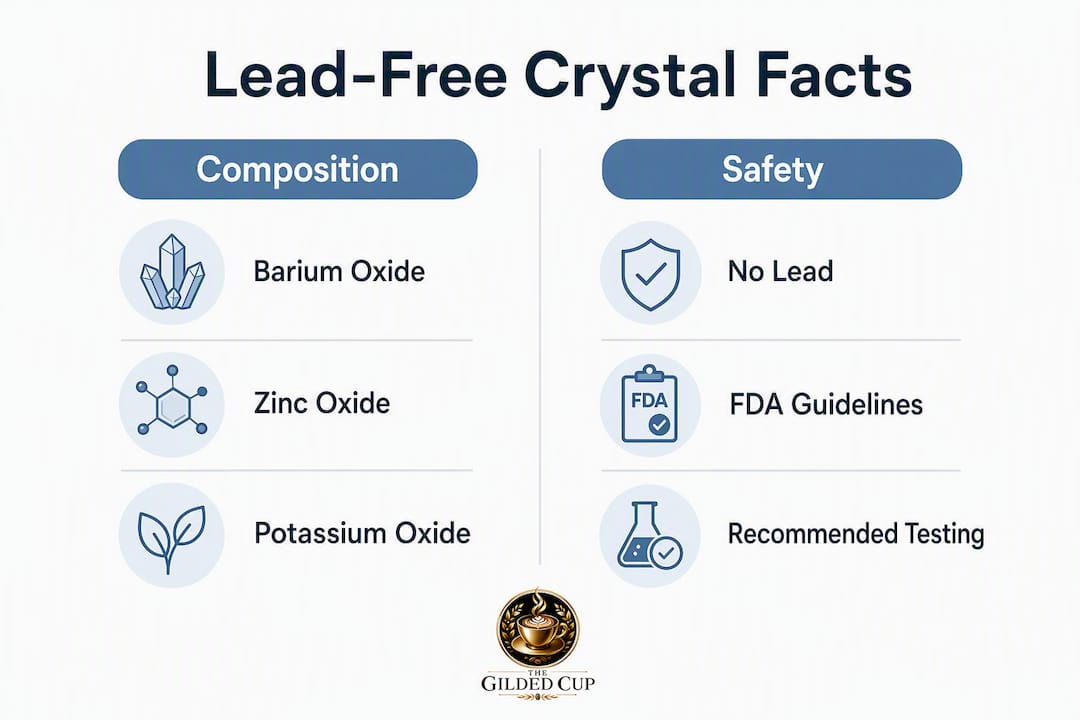
Industry classification recognizes that lead-free crystal replaces lead oxide with one or more of the following:
- Barium oxide (BaO): Raises refractive index and density closest to lead oxide; the most common direct substitute.
- Zinc oxide (ZnO): Improves clarity and workability; often combined with barium oxide.
- Potassium oxide (K2O): Increases brilliance and lowers melting point, making the glass easier to work.
- Magnesium oxide (MgO): Adds chemical durability; typically used in combination with other oxides rather than alone.
Each of these substitutes approximates what lead oxide does, but none replicates it exactly. Barium-based formulas come closest in refractive index and density. Zinc-based formulas tend to produce slightly lighter glass with good clarity. The practical result is a product that looks and sounds like lead crystal to most consumers, though collectors who handle both regularly can often detect a subtle difference in the ring tone and the depth of cut.
ISO IWA 43:2023 provides the authoritative classification framework, specifying composition thresholds, density requirements, and refractive index ranges that distinguish crystal glass, crystal, and lead crystal from one another. When a manufacturer claims their product meets a recognized crystal standard, this is the document behind that claim.
How lead-free crystal compares to lead crystal and ordinary glass
The differences between these three material categories are real and measurable, though their practical weight depends on what you are buying the glass for.
| Property | Lead crystal | Lead-free crystal | Ordinary glass |
|---|---|---|---|
| Composition | Silica + lead oxide (PbO) | Silica + BaO, ZnO, K2O, or MgO | Silica, soda ash, limestone |
| Refractive index / brilliance | Highest; deep sparkle and light dispersion | High; slightly less than lead crystal | Lower; noticeably less brilliant |
| Weight / density | Heaviest | Moderate; lighter than lead crystal, heavier than ordinary glass | Lightest |
| Cut and workability | Easiest to cut finely; holds sharp facets well | Good workability; slightly harder than lead crystal | Difficult to cut finely |
| Sound / ring | Long, clear, bell-like tone | Clear ring, shorter resonance | Dull thud |
| Food-contact safety | Lead leaching risk, especially with acidic liquids | No lead leaching risk when properly formulated | No lead concern |
| Dishwasher tolerance | Generally hand-wash only | Often dishwasher-safe per manufacturer specs | Typically dishwasher-safe |
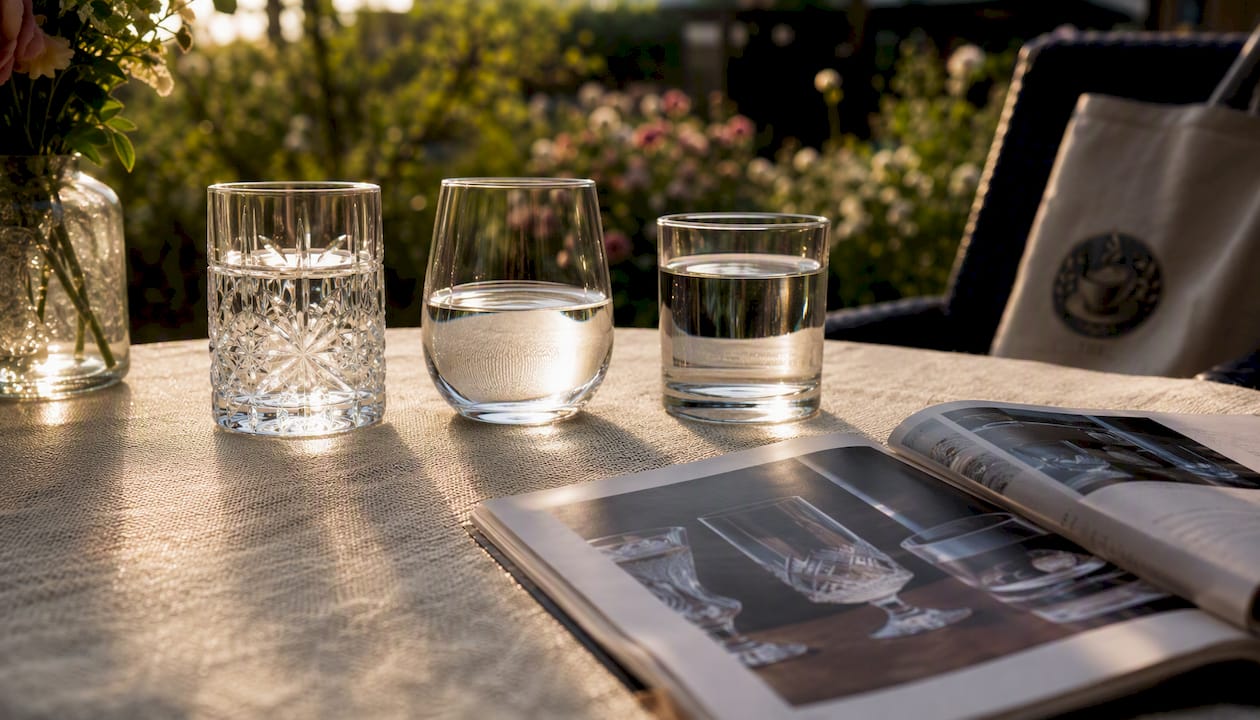
The weight difference is the most immediately noticeable thing when you pick up a lead-free piece. It sits between lead crystal and ordinary glass, which some buyers interpret as a quality cue and others find more comfortable for everyday use. The ring test, where you tap the rim lightly and listen, produces a clear tone in lead-free crystal, though the resonance fades faster than in lead crystal. That difference is audible but subtle enough that most dinner guests will not notice.
For collectors prioritizing cut depth and visual drama, lead crystal still holds an edge. For anyone buying glassware for regular food and drink use, the advantages of lead-free glass are straightforward: comparable brilliance, no lead exposure risk, and better dishwasher compatibility. Designer glassware in lead-free formulations has closed the aesthetic gap considerably over the past two decades, driven partly by manufacturers like Riedel who built their modern ranges around barium and zinc-based formulas.
Is lead-free crystal safe for food and drink?
Yes, with an important qualifier: the safety claim depends on verified composition, not just a label.
Traditional lead crystal carries a documented leaching risk. Lead oxide is soluble under acidic conditions, meaning that wine, citrus juice, or vinegar-based drinks stored in a lead crystal decanter can absorb measurable amounts of lead over time. The risk is highest with prolonged storage rather than brief serving, and it is most serious for pregnant people and young children, who are more vulnerable to lead exposure at lower levels.
Lead-free crystal removes that specific risk entirely, provided the product is genuinely lead-free and not simply low-lead. The distinction matters. A product labeled “crystal” without further specification may still contain lead oxide at levels below a traditional threshold. “Lead-free” as a label means the formulation contains no intentional lead oxide, but without third-party verification, it is a compositional claim rather than a tested result.
The evidence consumers should actually ask for:
- Material composition sheet: Lists the oxides present and their percentages. This is the baseline document.
- XRF (X-ray fluorescence) screening report: A non-destructive elemental analysis that confirms whether lead is present in the glass matrix.
- Leach/migration test results: Measures how much of any element transfers into a food simulant (typically an acidic solution) under controlled conditions. This is the most directly relevant safety test for food-contact use.
In the U.S., the FDA regulates lead in ceramics and pottery under food-contact rules, but glass and crystal do not fall under the same mandatory pre-market testing regime. That makes voluntary third-party testing the practical standard. Moser, one of the Bohemian manufacturers that shifted to lead-free formulas, cites both environmental and food-contact safety as the primary drivers for reformulation.
Practical precautions that apply regardless of crystal type: avoid storing acidic liquids (citrus juices, wine, vinegar-based drinks) in any decorative crystal decanter for extended periods unless you have confirmed food-contact certification for that specific piece. For everyday serving, a properly certified lead-free crystal glass carries no meaningful lead risk.
Pro Tip: If a seller cannot provide a composition sheet or test result, search for the product’s brand and “material safety data sheet” or “MSDS.” Many reputable manufacturers publish these documents publicly on their websites.
How to identify lead-free crystal at home and when to get lab testing
Most home identification methods give you useful clues, not definitive answers. Here is what each method actually tells you:
- Product specification sheet: The most reliable starting point. Look for an oxide list. If it names BaO, ZnO, or K2O and explicitly states “lead-free,” that is a compositional claim you can follow up with a lab test.
- Stamping or labeling: Some manufacturers stamp “lead-free” or “Pb-free” on the base or packaging. This is a declaration, not proof, but it narrows the field.
- Weight and thickness: Lead-free crystal is noticeably lighter than lead crystal of the same size. If a piece feels surprisingly heavy for its dimensions, that warrants further investigation.
- Ring test: Tap the rim gently with a fingernail. A clear, sustained tone suggests crystal-grade glass. A short or dull sound suggests ordinary glass. This test cannot distinguish lead crystal from lead-free crystal reliably.
- Edge and cut sharpness: Fine, sharp facets with clean edges indicate crystal-grade workability. Rounded or slightly soft edges suggest ordinary glass.
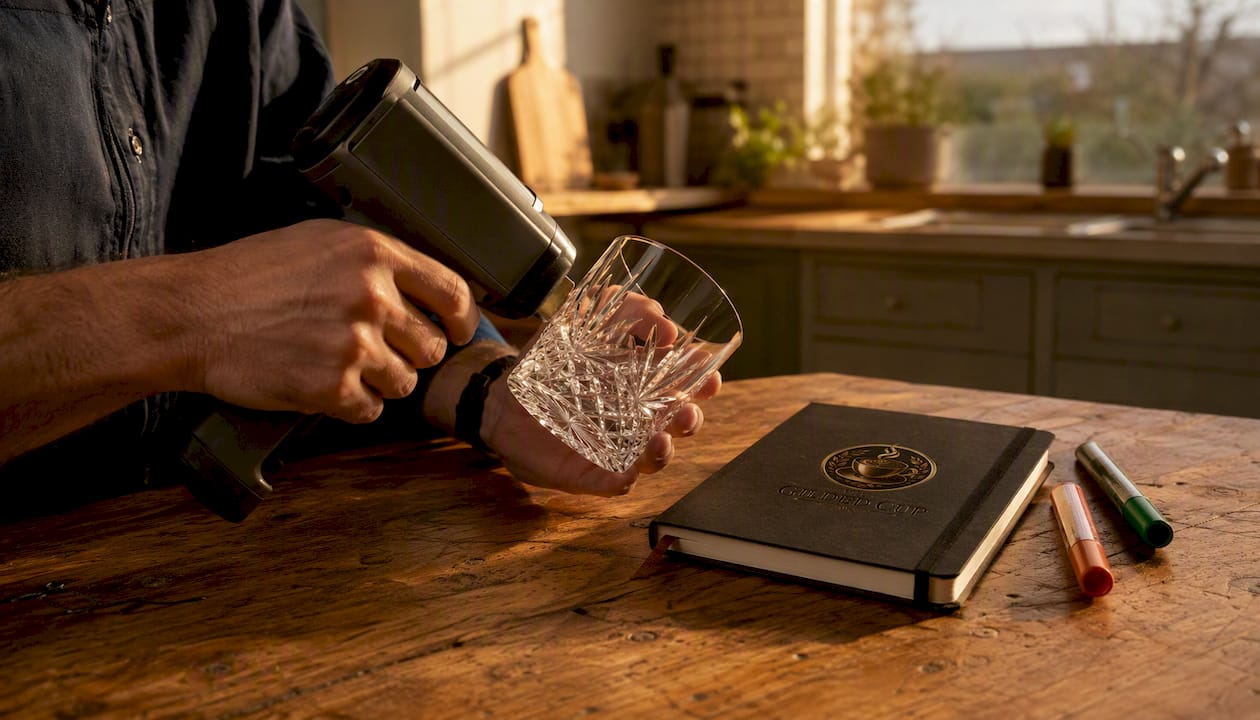
When those checks are not enough, professional testing is the answer. XRF screening detects elemental composition non-destructively and can confirm whether lead is present. Leach/migration testing goes further by measuring actual transfer into food simulants. Both are available through commercial testing labs in the U.S.
When talking to a seller, watch for ambiguous language. “Crystalline glass” often means ordinary glass with optical coatings or treatments, not true crystal composition. “Crystal glass” may or may not contain lead. “Lead-free crystal” is the specific claim you want, backed by a spec sheet or test result. Ask directly: “Does this product have a material composition sheet, and has it been tested for lead migration?”
Pro Tip: The ICIA (International Crystal Industry Association) publishes guidance on crystal classifications that can help you interpret manufacturer terminology before you buy.
Cleaning and caring for lead-free crystal
Lead-free crystal is more forgiving than lead crystal in daily use, but it still rewards careful handling. The core care principles apply across both types.
- Dishwasher use: Many lead-free crystal pieces are rated dishwasher-safe by their manufacturers, unlike traditional lead crystal, which almost always requires hand-washing. Check the manufacturer’s specific guidance before loading any crystal piece. Use a gentle cycle, low temperature, and a mild detergent without bleach or citrus additives.
- Hand-washing: When in doubt, hand-wash with warm (not hot) water and a small amount of dish soap. Rinse thoroughly to avoid soap film, which clouds brilliance over time.
- Temperature shock: Never move crystal directly from a hot dishwasher or hot water to a cold surface, or vice versa. Abrupt temperature changes can cause micro-fractures that weaken the glass structurally before any visible crack appears.
- Drying and polishing: Dry with a lint-free microfiber cloth immediately after washing to prevent water spots. For polishing, hold the piece over steam briefly to loosen mineral deposits, then buff gently with a clean cloth.
- Storage: Store crystal upright, not inverted on the rim. Rim-down storage concentrates the weight on the most fragile part of the glass. Keep pieces separated with cloth or foam dividers to prevent contact scratches.
For a more detailed cleaning protocol, Thegildedcup’s crystal care guide covers step-by-step preservation for both lead and lead-free pieces.
How standards and lab tests define “crystal” and measure lead content
The clearest authoritative reference for crystal classification is ISO IWA 43:2023, which defines crystal glass, crystal, and lead crystal by composition, density, and refractive index, and sets provisions about permissible lead content. It also specifies the test methods used to verify those classifications. For consumers, this standard is the benchmark against which manufacturer claims can be evaluated.
| Test type | What it measures | Why it matters to consumers |
|---|---|---|
| XRF (X-ray fluorescence) | Elemental composition of the glass matrix | Confirms whether lead or substitute oxides are present; non-destructive |
| Leach/migration test | Transfer of elements into a food simulant under controlled conditions | Directly measures food-contact safety; the most relevant test for drinking vessels |
| Density measurement | Mass per unit volume | Distinguishes crystal grades from ordinary glass per ISO classification |
| Refractive index measurement | Light-bending capacity of the glass | Verifies optical quality claims; higher index = more brilliance |
When requesting documentation from a seller or manufacturer, ask for:
- The specific test method used (e.g., ISO IWA 43:2023 for classification; EN 1388 or equivalent for leach testing)
- The units and limits reported (e.g., micrograms per liter for lead migration)
- Whether testing was conducted by a third-party accredited laboratory
A manufacturer who can provide those specifics is operating at a transparency level that marketing language alone cannot match. The ICIA notes that ISO-style classifications give product-agnostic thresholds, which means the same standard applies whether the piece comes from a Czech glassmaker or a U.S. retailer.
Key Takeaways
Lead-free crystal replaces lead oxide with barium, zinc, potassium, or magnesium oxides, achieving comparable brilliance without the food-contact safety risks associated with traditional lead crystal.
| Point | Details |
|---|---|
| Composition difference | Lead-free crystal uses BaO, ZnO, K2O, or MgO instead of lead oxide to achieve optical and density properties. |
| Safety for food and drink | Properly formulated lead-free crystal carries no lead leaching risk; verify with a composition sheet or leach-test result. |
| Identification at home | Use weight, ring tone, and cut sharpness as initial clues; only XRF or leach testing confirms composition definitively. |
| Care and cleaning | Many lead-free pieces are dishwasher-safe per manufacturer specs; avoid thermal shock and store upright to protect the rim. |
| What to ask a seller | Request a material composition sheet and third-party leach/migration test results before purchasing any crystal for regular food use. |
A collector’s perspective on lead-free crystal
The debate between lead crystal and lead-free crystal is often framed as a trade-off between beauty and safety, but that framing is increasingly outdated. The best lead-free formulations today, particularly barium-based ones from established European makers, are genuinely difficult to distinguish from lead crystal in a casual setting. The ring is slightly shorter, the cut marginally less crisp on very fine facets, but for most people serving wine or spirits at a dinner table, the difference is academic.
Where lead crystal still holds a real advantage is in the hands of serious collectors focused on antique or highly worked pieces, where the depth of cut and the sustained resonance are part of what they are paying for. For that audience, the aesthetic argument is legitimate. But for anyone building a set of everyday drinking glasses, entertaining glassware, or gifts, lead-free crystal is the practical choice without meaningful compromise.
What concerns me more than the lead-versus-lead-free question is the lack of transparency in how many products are sold. “Crystal” on a label tells you almost nothing without a composition sheet behind it. Thegildedcup’s approach of providing detailed product information is exactly what this category needs more of: specifics over marketing language, and verifiable claims over vague prestige signals. If a piece of glassware cannot tell you what it is made of, that is the real red flag.
Useful sources and further reading
- ISO IWA 43:2023 — Glass types: Crystal glass, crystal and lead crystal — The primary international standard defining crystal classifications by composition, density, and refractive index, with test method specifications. Start here when evaluating any manufacturer’s classification claims.