

Luxury Hotel Amenity Standards: A Buyer's Guide
Luxury hotel amenity standards are the combination of consistent, anticipatory service, high-quality physical products, and flawless presentation that together define a guest’s experience as genuinely five-star. The Forbes Travel Guide evaluates properties against comprehensive criteria, with service receiving the majority of the overall weight. The AAA Diamond Program applies its own North American checklist. Both frameworks share a core principle: the existence of an amenity counts for far less than how it is delivered.
For hospitality buyers sourcing luxury drinkware and branded glassware, that principle has a direct procurement implication. A crystal-clear wine glass means nothing if it arrives chipped, sits misaligned on the nightstand, or gets replaced only after a guest notices it is empty.
- Luxury = service + product quality + presentation/delivery, evaluated together
- Forbes Travel Guide and AAA Diamond Program are the two dominant U.S.-relevant measurement frameworks
- Anticipation and personalization matter as much as the physical object
- Thegildedcup supplies hospitality-grade drinkware designed to meet these standards
Pro Tip: When vetting a drinkware supplier, test delivery consistency before material specs. A beautiful glass that ships inconsistently or breaks above an agreed threshold fails the standard before a guest ever touches it.
Table of Contents
- What luxury amenity standards actually cover
- How luxury standards are set and measured
- What drinkware specs should hospitality buyers require?
- What to ask suppliers before you place an order
- What to budget and how long it takes
- U.S. safety and sustainability requirements to build into specs
- How to operationalize these standards on property
- Key Takeaways
- The gap between a beautiful glass and a luxury standard
- Thegildedcup for hospitality procurement
- Useful sources for U.S. hospitality buyers
What luxury amenity standards actually cover
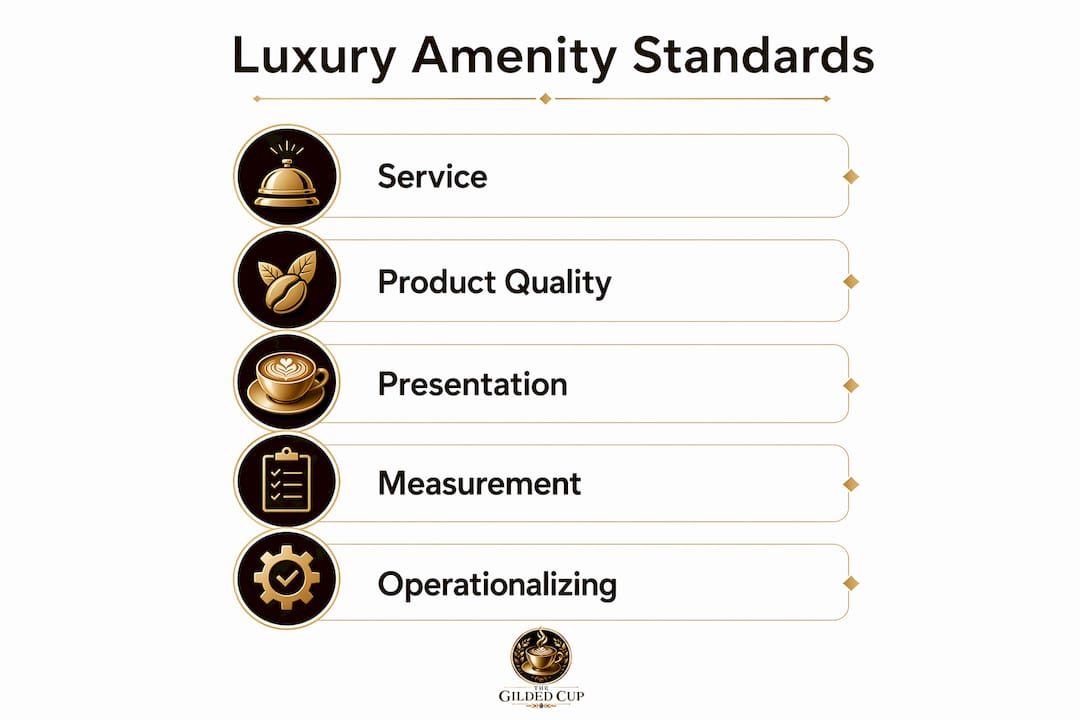
Three pillars hold up every credible definition of luxury hotel amenity standards: service, product quality, and presentation.
Service is the largest pillar. Five-star properties maintain 24-hour responsiveness, dedicated concierge and butler programs, nightly turndown, and staff-to-guest ratios of 2:1 or higher. Personalization sits at the center of all of it. Guests expect staff to know their names, anticipate preferences, and solve problems before they are voiced.
Product quality covers every tangible item a guest touches. Premium toiletries, high-thread-count linens, a thoughtfully stocked minibar, and hospitality-grade drinkware all fall here. The material, finish, and durability of each item signal investment or cost-cutting instantly.
Presentation and delivery is where most properties lose points. Forbes-style standards require housekeeping to align bath products precisely and replenish items before they reach halfway depletion, maintaining the appearance of an untouched, fully stocked room. The same logic applies to in-room glassware: placement, polish, and replenishment timing are measurable.
That quote cuts to the heart of what separates a genuine five-star property from one that simply calls itself luxury. For a drinkware buyer, it translates directly: specify the standard, then build the SOP to enforce it.
How luxury standards are set and measured
No single global checklist governs what defines luxury hotel features. Three frameworks dominate the conversation for U.S. buyers.
Forbes Travel Guide inspects each property for a minimum of two nights using more than 900 objective criteria, with service weighted at roughly 70% of the total score. A Five Star designation requires what Forbes calls a “highly customized level of service,” not a checklist of amenities.
AAA Diamond Program is the primary North American rating system. Its Five Diamond designation evaluates facilities, service, and overall guest experience through a combination of announced and unannounced inspections.
Hotelstars Union applies to 21 European countries and mandates specific physical requirements at the five-star level: 24-hour reception, valet service, evening turndown, in-room safe, bathrobe, and slippers. It is a useful reference benchmark even for U.S. buyers sourcing from European suppliers.
On-property, hotels enforce these standards through:
- Written SOPs for every guest-facing touchpoint (placement, replenishment, cleaning)
- Daily QA checklists completed by housekeeping supervisors
- Mystery shopper programs that score against Forbes or AAA criteria
- Guest satisfaction surveys tied to service-response SLAs
- Staff-to-room ratio tracking as a proxy for personalization capacity
Stat to know: Forbes Travel Guide gives service the greatest weight in its evaluation score, meaning a property with exceptional glassware but slow replenishment will still fail a Five Star inspection.
What drinkware specs should hospitality buyers require?
Product specifications for luxury drinkware belong in every RFP. Vague language like “high-quality glass” gives suppliers room to cut corners.

| Item Type | Material | Min. Wall Thickness | Dishwasher Rating | Lead Content Spec | Required Testing |
|---|---|---|---|---|---|
| Wine glass | Lead-free crystal alternative or borosilicate | ±0.2 mm | at least 300 dishwasher cycles | 0 ppm (Prop 65 compliant) | Drop test, thermal shock |
| Water glass | Tempered or borosilicate glass | — | at least 300 dishwasher cycles | 0 ppm | Chip resistance, abrasion |
| Branded mug | Ceramic or borosilicate | — | at least 300 dishwasher cycles | 0 ppm | FDA food-contact cert |
| Champagne flute | Lead-free crystal alternative | — | 300+ cycles | 0 ppm | Rim thickness tolerance ±0.2 mm |
| Decanter | Lead-free crystal alternative | — | Hand-wash rated | 0 ppm | Thermal shock, clarity spec |
A few points worth calling out. Hand-blown glass carries natural variation in wall thickness; require a tolerance spec (±0.2 mm is standard for hospitality grade) rather than a single nominal figure. Borosilicate performs better under thermal shock than standard soda-lime glass, which matters for coffee mugs and tea glasses that go from cold storage to hot liquid. For branded pieces with gold or silver accents, require testing that confirms the finish survives at least 300 dishwasher cycles without fading or flaking.
Pro Tip: Request a pre-production sample run of 10–20 pieces before committing to a full order. Run them through your property’s actual dishwasher on your standard cycle, check rim integrity, and verify that any engraving or accent finish holds. This step costs almost nothing compared to a full-order replacement.
For hospitality-grade glassware buyers, the testing checklist should include: production samples with lab reports, California Proposition 65 compliance certificates, FDA food-contact statements, batch-testing frequency documentation, and drop-test counts per batch.
What to ask suppliers before you place an order
A structured vetting process saves significant cost and operational disruption. Work through these steps in order.
- Request a full spec sheet covering material composition, wall thickness tolerances, dishwasher cycle rating, and surface finish specifications.
- Ask for compliance certificates — FDA food-contact compliance and California Proposition 65 lead-content certificates for any crystal or crystal-alternative product.
- Confirm minimum order quantity (MOQ) and lead times for both samples and production runs, including any customization (engraving, branding, accent finishes).
- Request pre-production samples and run your own dishwasher and drop tests before approving production.
- Clarify batch traceability — suppliers should be able to identify which production batch any piece came from, which matters when a defect pattern emerges post-delivery.
- Agree on a breakage threshold — define the acceptable defect rate on delivery (typically 0.5–1% for luxury grade) and require a replacement policy for anything above it.
- Specify packaging requirements — single-item wrapping, display trays for in-room presentation, recyclable outer packaging, and housekeeping-friendly labeling.
- Confirm warranty and repair policy — what happens if a finish defect appears after 90 days of service?
What to budget and how long it takes
Hospitality buyers pay a premium over retail pricing for tested, service-grade drinkware. That premium buys consistency, compliance documentation, and the durability needed for high-rotation use.
Unbranded tempered glass tumblers typically run in the range of a few dollars per piece at hospitality volume. Premium lead-free crystal alternatives with standard finishes sit meaningfully higher. Hand-finished branded pieces with engraving or precious-metal accents can reach multiples of that, depending on the artisan process and batch size. Customization always adds cost; the smaller the batch, the higher the per-unit premium.
For lead times, plan on two to three weeks for sample production and shipping. Pre-production approval, including your own testing cycle, adds another one to two weeks. Full production runs for branded hospitality orders typically take six to ten weeks, plus shipping and customs clearance for international suppliers. Build a four-week safety buffer into any timeline that involves a property opening or seasonal rollout.
U.S. safety and sustainability requirements to build into specs
Compliance is not optional, and it is not the supplier’s problem alone. U.S. buyers carry responsibility for what goes into guest rooms.
- FDA food-contact compliance: Require a written statement and third-party lab report confirming all drinkware meets FDA food-contact material standards. This applies to glass, ceramic glazes, and any decorative finish that contacts food or beverage.
- California Proposition 65: Traditional lead crystal contains lead oxide, which triggers Prop 65 warnings in California. Require zero-lead or lead-free crystal alternatives and a certificate of compliance. This is non-negotiable for any property with California guests or any product sold into the California market.
- Refillable and recyclable packaging: Luxury hospitality is shifting away from single-use disposable amenity bottles toward refillable, premium dispensers. Apply the same aesthetics-first logic to drinkware packaging: recyclable outer cartons, reusable display trays, and packaging that presents as premium rather than cost-cutting.
- Supply chain transparency: Ask suppliers for recycled content percentages, information on take-back or repair programs, and documentation of their own environmental certifications.
- Contract documentation: Safety certificates should be attached as exhibits to purchase contracts, not just emailed separately. This reduces legal exposure and simplifies audits.
How to operationalize these standards on property
Buying the right glass is step one. Getting it consistently in front of guests, in perfect condition, every night, is the actual standard.
A practical rollout follows this sequence: validate samples on a pilot floor, update SOPs to reflect placement and replenishment rules, train housekeeping and F&B staff on handling and inspection criteria, then expand to full property. Do not skip the pilot floor. Issues with balance, rim fragility, or dishwasher compatibility surface in a controlled setting rather than across 200 rooms simultaneously.
Replenishment rules matter more than most buyers expect. Forbes-standard housekeeping replenishes items before they reach halfway depletion. For in-room drinkware, that means a par-level system: each room carries a defined number of pieces, with spares staged in housekeeping carts, and replacement triggered by condition inspection rather than guest complaint.
Daily QA checklists should include a visual inspection of every glass for chips, cloudiness, or finish wear. Periodic batch testing, pulling a sample of pieces from rotation for a dishwasher cycle count check, catches degradation before it reaches guests. Guest feedback that flags a drinkware issue should trigger a supplier remediation conversation, not just a one-off replacement.
The luxury table setup principles that apply in fine dining translate directly to in-room presentation: alignment, polish, and intentional placement signal care even before a guest picks up the glass.
Key Takeaways
Luxury hotel amenity standards require service consistency, testable product specs, and documented compliance working together — no single element substitutes for the others.
| Point | Details |
|---|---|
| Service outweighs product | Forbes Travel Guide weights service as the majority of its score; delivery discipline matters more than material alone. |
| Demand testable specs | Require wall thickness tolerances, dishwasher cycle ratings, and drop-test results in every RFP. |
| Compliance is contractual | Attach FDA food-contact statements and California Prop 65 certificates as contract exhibits, not email attachments. |
| Build replenishment SOPs | Replenish in-room drinkware before halfway depletion; daily visual inspection catches defects before guests do. |
| Thegildedcup for procurement | Thegildedcup supplies hospitality-grade drinkware with customization options and pre-shipment QA support for hotel buyers. |
The gap between a beautiful glass and a luxury standard
Most procurement conversations start with the object: the weight of the glass, the clarity of the crystal, the elegance of the engraving. Those things matter. But the standard is not the object. It is the system around the object.
A hotel that sources exceptional glassware and then places it inconsistently, replenishes it reactively, and skips the compliance documentation has not met a luxury standard. It has bought a nice glass. The Forbes Travel Guide and AAA Diamond Program both measure the system, not the purchase order.
What gets underestimated most often is the operational cost of getting this right. SOPs, par levels, staff training, QA checklists, supplier remediation protocols — these are not bureaucratic overhead. They are what separates a property that earns a Five Star rating from one that aspires to it. Buyers who treat drinkware as a one-time purchase rather than an ongoing operational commitment will find themselves replacing stock reactively, managing guest complaints, and renegotiating with suppliers from a weak position.
The smarter approach: specify the standard before you specify the product, build the SOP before the first delivery arrives, and choose suppliers who can document their quality process, not just describe their materials.
Thegildedcup for hospitality procurement
Thegildedcup brings together curated luxury drinkware and branded glassware built for the demands of hotel procurement, not just retail display. The difference shows up in the details: pre-shipment QA checks, customization options that survive commercial dishwasher cycles, and concierge-style support for buyers navigating MOQs, lead times, and compliance documentation.
Whether you need a sample pack to validate specs on a pilot floor, a branded mug program for in-room coffee service, or a full glassware suite for a property opening, Thegildedcup handles the sourcing, customization, and quality verification. Explore the full range and start a procurement inquiry at thegildedcup.co.
Useful sources for U.S. hospitality buyers
- Forbes Travel Guide: The primary inspection framework for Five Star designation in the U.S.; use its 900-plus criteria and service-weighting as the benchmark when writing internal SOPs or justifying investment.
- AAA Diamond Program: North America’s most widely recognized hotel rating system; its Five Diamond checklist is the standard reference for U.S. property operators and procurement teams.
- Hotelstars Union: The European classification body covering 21 countries; useful as a comparative reference when sourcing from European suppliers or benchmarking physical amenity requirements.
- FDA food-contact guidance: The U.S. Food and Drug Administration’s food-contact material standards apply to all drinkware, ceramic glazes, and decorative finishes; require supplier compliance statements against these standards.
- California Proposition 65: Governs lead and other chemical disclosures for products sold or used in California; mandatory compliance certificates for any crystal or crystal-alternative drinkware.
- EHL Insights on luxury hospitality: Practitioner-level analysis of what defines luxury service; useful for framing internal training and SOP language around anticipation and personalization.