

Carnival Glass: A Buyer's Guide to Identification and Value
Carnival glass is pressed or molded glass coated with an iridescent metallic-salt finish that produces a shifting rainbow sheen across the surface. Manufacturers applied that finish by spraying a solution of metallic salts onto the hot glass, then refiring it to create a permanent chemical bond. The classic production period ran roughly 1907 through the 1930s, with later revivals beginning in the 1970s. The name itself came from collectors in the 1950s, partly because second-quality pieces were given away as carnival prizes, though most pieces were sold as affordable decorative household glass, not handed out at fairgrounds.
- The finish: metallic salts sprayed on hot glass, then refired for a permanent bond
- Classic era: approximately 1907–1930s; revivals from the 1970s onward
- The name: collector-coined in the 1950s, not a manufacturer’s term
- Buyer relevance: condition, color rarity, and maker attribution drive value significantly; upscale buyers and retailers need to verify all three before purchasing
Table of Contents
- What is carnival glass, and how do you spot it fast?
- How carnival glass was made, and why history matters to buyers
- Can you tell classic carnival glass from a later reproduction?
- How to clean and store carnival glass without damaging it
- Practical buying checklist for retailers and upscale consumers
- Key Takeaways
- What experienced buyers actually notice first
- Curated collectible glassware, sourced for upscale buyers
- Useful sources for further research
What is carnival glass, and how do you spot it fast?
The fastest identification cue is the iridescent surface. Tilt a piece under natural light and watch for a rainbow shimmer that shifts as the angle changes. That optical effect comes from light interference at the metallic-salt coating, similar to the colors you see on a soap bubble or a thin film of oil on water.
Beyond the sheen, run your fingers across the surface. Authentic carnival glass is mold-pressed, so you will feel the pattern in relief, not just see it. Common base glass colors include marigold (a warm golden-orange), amethyst, cobalt blue, aqua, and green. Typical shapes are bowls, compotes, vases, pitchers, and tumblers.
“Glass MUST have the iridescent overspray of metallic salts in order to be considered carnival glass. If the glass is not iridized, it is NOT Carnival.” — Carnival Heaven, How Carnival Was Made
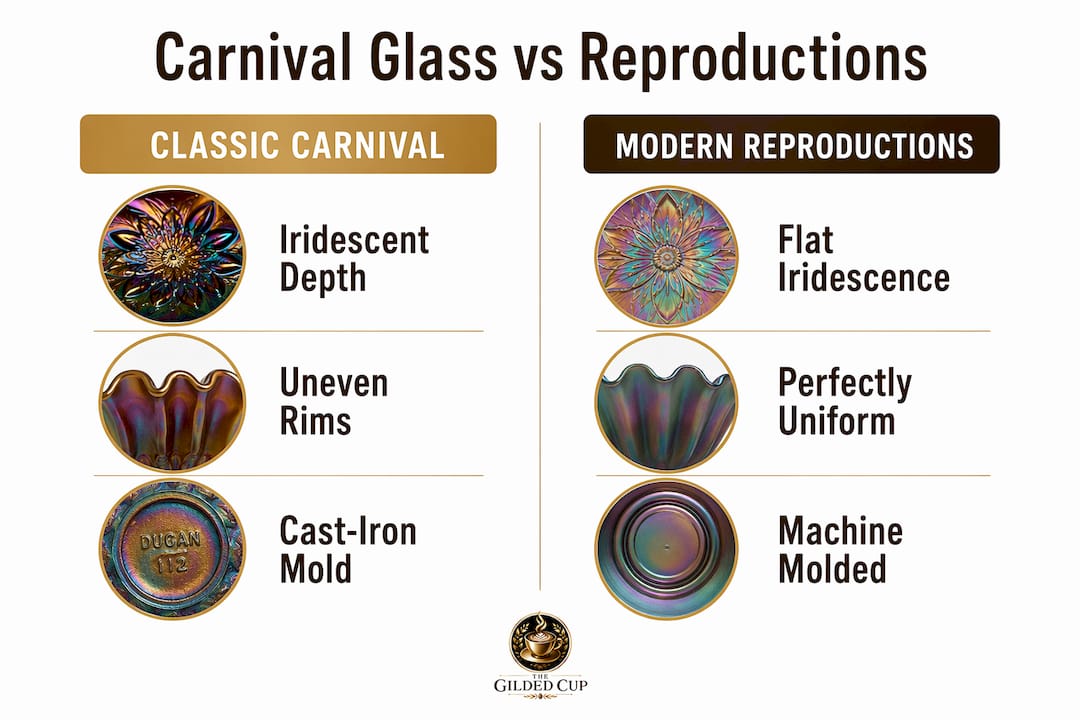
Red flags for modern reproductions: a soft, flat iridescence that lacks depth; rims that are perfectly uniform with no hand-finishing variation; modern paper labels or embossed date stamps; and bases that are uniformly bright with no age-appropriate wear.
Pro Tip: Photograph the base and the rim separately under raking light before any purchase. Classic pieces often show light scratching and contact-point dulling at the base, which is actually a useful age indicator. A reproduction base is typically unmarked and bright.
How carnival glass was made, and why history matters to buyers
The process started with molten glass pressed into cast-iron molds, where patterns had been chiseled in reverse by skilled craftsmen. After pressing, the piece was reheated at the furnace’s “glory hole” and hand-shaped with wooden paddles to create ruffled rims and other edge variations. Only after shaping was the iridescent finish applied: a metallic-salt solution was sprayed onto the still-hot glass, then the piece traveled through a lehr, an enclosed conveyor that cooled it slowly over roughly 24 hours to prevent stress fractures.
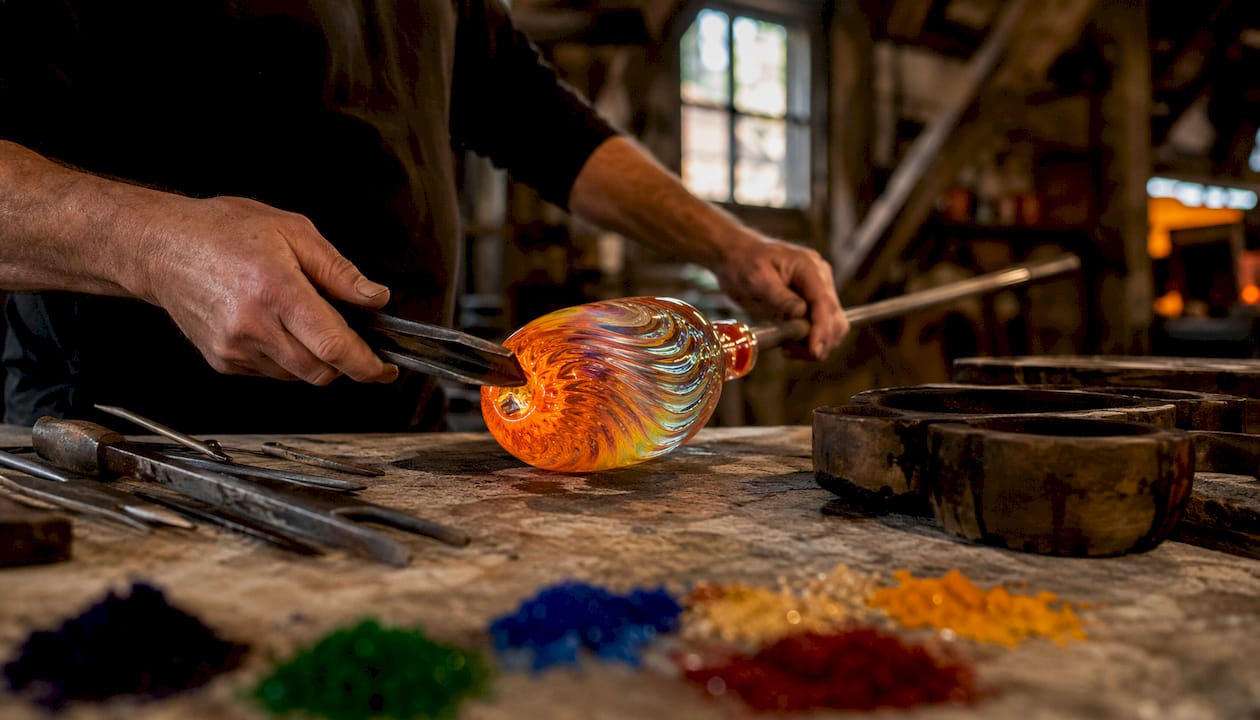
The technique traces back to Bohemia around 1856, where iridescence on glass was first developed intentionally. By the early 1900s, American manufacturers saw the opportunity to deliver a Tiffany-like iridescent look at a fraction of the cost. A Tiffany vase required close to two months’ wages for an average worker; a dozen iridized vases from Fenton wholesaled for under a dollar.
| Period | Key Event |
|---|---|
| ~1856 | Bohemian glassmakers develop intentional iridescence on glass |
| 1907–1930s | Fenton introduces Iridill; large-scale U.S. production begins |
| approximately 1907–1930s | Peak “Classical Carnival” era; Northwood, Imperial, Millersburg, Dugan-Diamond join Fenton |
| 1930s | Market slows; some pieces distributed as prizes |
| 1970s onward | Revival production begins in the U.S. and internationally |
Because the spraying stage was a skilled manual process, slight variances in temperature and spray layers produced unique iridescent effects. Two bowls from the same mold can look noticeably different. That variability is a feature of authentic classic pieces, not a defect.
- Hand-finishing after molding means rims and edges vary even within the same pattern
- Base glass color (clear, amethyst, cobalt, green) is set before the iridescent spray and is a key attribution cue
- Marigold carnival glass always uses clear base glass; the orange color comes entirely from the metallic-salt coating
Can you tell classic carnival glass from a later reproduction?
Most classic carnival glass carries no manufacturer’s mark. Attribution relies on pattern repertoires, color bases, and the known habits of the “Big Five” U.S. makers: Fenton, Northwood, Imperial, Millersburg, and Dugan-Diamond. European and South American producers added their own patterns and color bases, which affects regional rarity and pricing.
Physical tests that separate originals from revivals:
- Base wear: authentic older pieces typically show light abrasion and contact-point dulling; a uniformly bright, unmarked base suggests a reproduction
- Iridescence intensity: classic pieces tend to display a more vibrant, deeply layered finish than modern reproductions, which often show a softer, flatter sheen
- Mold sharpness: early molds were freshly cut; pattern detail on classic pieces is crisp; worn or re-used molds on later pieces produce softer relief
- Rim variation: hand-finishing creates subtle irregularities; perfectly uniform rims are a reproduction signal
- Color base: knowing which color bases a specific maker used narrows attribution considerably
Pro Tip: Before resale or consignment, document the piece with photos under neutral daylight: one shot of the rim, one of the inside base, and one showing the iridescence at a 45-degree angle. This documentation speeds up expert attribution and protects you if condition questions arise later.
For high-value pieces, a formal appraisal from a specialist familiar with the Glass Encyclopedia or the National Depression Glass Association is worth the cost.
How to clean and store carnival glass without damaging it
The iridescent coating is durable but not indestructible. Harsh abrasives, dishwashers, and acidic cleaners can dull or strip the metallic-salt finish permanently.
Safe cleaning steps:
- Hand-wash only, using lukewarm water and a small amount of mild dish soap
- Use a soft cloth or sponge; never a scrubbing pad
- Rinse thoroughly and air-dry upright, or pat dry with a lint-free cloth
- Store pieces with felt or foam padding between them to prevent contact scratches
For display, avoid direct sunlight for extended periods, which can fade certain color bases over time. Marigold and amethyst pieces are particularly sensitive to prolonged UV exposure.
Value drivers to know before you buy:
- Color rarity: aqua opalescent and ice blue command significantly higher prices than common marigold
- Pattern rarity: pictorial and figurative patterns typically outvalue geometric ones
- Condition: chips, rim nicks, and base scratches reduce value; heavy abrasive cleaning that dulls the iridescence is often worse than minor wear
- Maker attribution: a confirmed Northwood or Millersburg attribution adds value over an unattributed piece in the same pattern
- Provenance: documented ownership history supports both authenticity and pricing
Restoration work, including re-sprayed iridescence or filled chips, reduces collector value substantially. Always ask sellers directly whether any restoration has been done, and examine the finish under a UV light, which can reveal re-sprayed areas.
Practical buying checklist for retailers and upscale consumers
Whether you are sourcing for a boutique retail display, a hospitality setting, or a personal collection, a consistent inspection process protects your investment. For collecting rare glassware with confidence, the steps below apply whether you are buying a single piece or a lot.
- Verify iridescence under natural light; look for depth and color shift, not a flat sheen
- Examine the base under raking light for age-appropriate wear
- Document condition with photos before purchase (rim, base, and iridescence angle)
- Confirm whether any restoration has been done; ask for written disclosure
- Estimate a price band based on color, pattern, condition, and maker attribution
- Separate pieces for display use from those suitable for actual table service
For hospitality buyers: carnival glass works well as decorative staging and display, but active table service risks chipping the iridescent finish. Use reproduction or revival pieces for service; reserve classic pieces for display. For seasonal tablescape settings, marigold and amethyst pieces photograph exceptionally well under warm lighting.
When buying lots at auction or estate sales, inspect at least a representative sample before committing. Factor in any restoration costs, and use clear condition grading in your listings: “excellent,” “very good,” “good with minor wear,” and “restored” are the standard descriptors collectors and buyers expect.
Key Takeaways
Carnival glass’s defining characteristic is its permanent iridescent finish, created by spraying metallic salts onto hot glass and refiring it, and condition plus color rarity are the two factors that most directly determine what a piece is worth.
| Point | Details |
|---|---|
| Defining finish | Metallic salts sprayed on hot glass and refired create a permanent, shifting iridescent sheen. |
| Classic era | The original production period ran roughly 1907–1930s; pieces from this window are “Classical Carnival.” |
| Maker attribution | Most classic pieces carry no maker’s mark; attribution relies on pattern, color base, and known maker habits. |
| Top value drivers | Color rarity, pattern rarity, condition (no chips or abrasive wear), and confirmed maker attribution drive price. |
| Thegildedcup | Thegildedcup offers curated collectible glassware with condition notes, supporting confident purchases for upscale buyers. |
What experienced buyers actually notice first
The conversation around carnival glass tends to focus on patterns and colors, and those matter. But the detail most buyers underestimate is finish variability. Because the metallic-salt spray was applied by hand at a specific temperature window, no two pieces are truly identical, even from the same mold run. That variability is precisely what gives classic carnival glass its character and, frankly, its staying power as a collectible.
The “poor man’s Tiffany” framing is accurate historically but misleading as a value judgment today. A rare Northwood piece in ice blue opalescent can command prices that would surprise anyone who dismisses the category as mass-market glass. The mass production was real; the rarity of specific color and pattern combinations within that production is equally real.
For buyers sourcing pieces for upscale retail or hospitality display, the practical takeaway is straightforward: prioritize depth of iridescence and condition over pattern name alone. A common pattern in an exceptional color with a clean finish will outperform a rare pattern in poor condition every time, both aesthetically and at resale.
Curated collectible glassware, sourced for upscale buyers
Thegildedcup takes the guesswork out of sourcing collectible and carnival-style glassware for retail display, gifting, and hospitality settings. Every piece in the collection comes with detailed condition notes and high-quality photography, so you know exactly what you are getting before it ships.
Whether you are building a retail display, stocking a hospitality venue, or adding to a personal collection, Thegildedcup’s curated selection covers the full range from classic iridescent styles to contemporary artisan drinkware. Browse the full collection at Thegildedcup and find pieces that are ready to display, gift, or resell with confidence.
Useful sources for further research
The resources below are the most reliable starting points for pattern identification, maker attribution, appraisals, and deeper historical reading.
- Glass Encyclopedia / The Glass Museum: detailed manufacturer histories, pattern photographs, and production context for the major U.S. makers
- National Depression Glass Association (NDGA): collector organization with articles on carnival glass history, shows, and appraisal referrals
- Carnival Glass Worldwide: extensive coverage of global production, social context, pattern repertoires, and maker identification
- GlassBottleMarks: practical identification guidance and reproduction red flags
- Wikipedia — Carnival Glass: a solid starting overview with links to further reading on specific makers and periods
For appraisals, the NDGA maintains a network of specialist appraisers. Before any appraisal, photograph the piece under neutral daylight (rim, base, and iridescence at 45 degrees) and note any known provenance. That documentation makes the appraiser’s job faster and your result more reliable.